Pages

Sunday, January 30, 2011

Pâtés, forcemeats and terrines; notes from a demo class at Formaggio Annex

This past Sunday, January 23rd, saw Formaggio Kitchen's charcutier extraordinaire, Julie Biggs, give a demo/tasting about three types of pâtés: chicken liver mousse, Pâté de Campagne and a rabbit pâté, all of which she regularly makes and sells at Formaggio Kitchen.

Left to right: Chicken liver mousse, Pâté de Campagne, Rabbit Pâté

The main thing to keep in mind when making any charcuterie (pâtés, sausages, aged meats) is to begin with high quality meat. Your results can only be as good as what you begin with, so make sure to go the extra distance to track down free-range chicken livers, humanely-raised pork products, sustainably-farmed game and make sure that everything is F-R-E-S-H!

The event was held at Formaggio's Annex, which is where they do all of their mail order and sometimes hold demos like this. The front half of the warehouse looks like a set from a television show on gourmet food preparation, complete with the stainless-steel table with a slanted mirror above it so that everyone can get a bird's-eye view without crowding around the work area. It's a nice set-up, but on this cold, cold evening it was a bit frigid.

We began with a nice glass of mulled wine, which at least took the chill off, and a Gruyère puff, which was a nice complement. Then it was down to business. The chicken liver mousse is a relatively simple affair, combining butter, rendered duck fat, chicken livers, white pepper, salt, cream, brandy and egg yolks.

Blend softened butter and duck fat (1/4 lb of each) until creamy. Then add the cleaned chicken livers (8oz) one at a time until combined. Then add the egg yolks (4) one at a time until combined. Separately, make a slurry of 3/4T kosher salt, 1/2 t white pepper, 1T cornstarch (for binding, this is optional, but if you're putting out of it's cooking dish to stand on its own, it is helpful), and 1T brandy, then add to the liver combo and mix. Bring 1c heavy cream to a scald then let it cool until it's warm enough to touch. Transfer the liver mixture into a large bowl and blend in the cream. Strain this through a fine mesh chinois.

Everything is put into a cooking dish (usually a loaf pan or terrine) and placed into a water bath, covered with foil and cooked at 325ºF for about 40m, or until they lightly set (it should still have a little bit of a jiggle to it, but it shouldn't be too liquid-y). If it's cooked too long it will begin to rise. This will add air into the mousse and give it a non-mousse consistency.

Julie made four mousses (or is it just mousse?) and put them in the oven so that we would be able to see from beginning to end the process of cooking this pâté. Then we were passed out a plate with samples of the three pâtés that we were learning how to make along with some white wine and three kinds of mustard (a whole-grain, a tomato and a grape must - all of them quite nice). While we were enjoying these, Julie moved on to discussing the makings of the Pâté de Campagne.

This pâté is essentially a meat loaf and while it, too, is not very difficult, there are some steps that need to be followed fairly closely in order for it to come together properly. The meat needs to have a good amount of fat when grinding down, so fat back, bacon and pancetta are added for both flavor and fat content. The fat helps the meat to bind properly, whether your making sausages or terrines you always want to have at least 30% fat to the total amount of meat. Julie's Pâté de Campagne calls for 2lbs port butt (because this will be a well treated pig that you're getting your meat from, there is likely to be a good amount of fat already included in this cut, but you still need more), 1/2 lb fat back, 1/4 lb bacon, 1/4 lb pancetta. When grinding your own meat, the key is to keep everything cold or else the meat won't so much grind as it will emulsify in the grinder and not come out properly. When chilling your meat, it is best to have it already cut into cubes and then salt it all with about 3/4T salt.

After the meat is ground, keep the mixture cold while preparing the binder: combine 3 cloves garlic, roughly chopped, with 2 shallots (same), 2T chopped parsley, 2t fresh thyme, a pinch of oregano, 1T pâté spice (a mixture of sweet paprika with some allspice, black pepper, garlic, ginger, etc.), 1/2T black pepper, 1/4c brandy, 1/4c red wine, 1/8c dry sherry (not sweet!), 1T tawny port. Blend this mixture together until the shallots and herbs are finely mixed. Add 4oz of cleaned chicken livers, 1 egg and 1 3/4 c light cream and blend well to emulsify. When you add the livers and egg in with the alcohol mixture, make sure to blend it together quickly because if you leave it unblended too long, the alcohol will actually cook the liver and egg, which you do not want to happen.

Combine the meat mixture with the emulsified binder. Finely dice 1c jambon de paris (or other ham) and stir into the mix. Add 1/4c blanched peppercorns as well. These are interior garnishes. (One can add all sorts of interior garnishes to terrines depending on what the flavor profile is. For the rabbit pâté there are pistachios added, you could do dried fruits, other meats, other vegetables, just be sure to make it appetizing.) Pack all of this into a terrine, making sure that there are no air pockets, and top with caul fat. Bake @ 325ºF, covered with foil, in a waterbath until the internal temp reads 135º. Remove foil and continue to bake until the internal temp is at 155º (total, about 2hrs).

Top: Pâté de Campagne covered with caul fat
Bottom: Rabbit pâté covered with pancetta

I do not have a recipe for the rabbit pâté, but it shouldn't be too different from the Pâté de Campagne, just with fewer up-front spices. When spicing a terrine, you want to make sure that you are using appropriate spices and not overloading a subtler meat with a lot of forward flavors. The rabbit pâté is covered with pancetta to add some more flavor as well as give it some added fat when it cooks. It is finished off, after it has cooled and set, by pouring aspic around the entire terrine (the chicken liver mousse is also finished off by pouring aspic over top of it and garnishing with cornichons).

 Rabbit pâté covered in aspic

To make a simple aspic, without worrying about hooves and other bones, gelatin sheets are used: 25 sheets per quart of liquid. The liquid in this particular case being Madeira. Flame the Madeira and season with salt and sugar. Bloom the gelatin sheets in ice water for about 5min, then place in the warm liquor and stir until dissolved. It couldn't be simpler than that. It can keep refrigerated, to re-liquefy just place in a double boiler.

When using the aspic, pour over or on top of whatever you are wanting to encase and let sit, undisturbed, until set ~45m - 1hr, then refrigerate to set completely.

This was a really fun course to be at, quite tasty, and it certainly answered a couple of questions that I had. I hope I can answer yours....


Smoked

As I usually do with the bacon that I make, I divided each piece in half and smoked one half and baked the other. Since I began making bacon I have been interested in the taste difference between the smoked version of the cure spices and a "fresh" version. This being my first batch made with the Mangalitsa belly I especially wanted to taste the fresh bacon, unhindered by the flavor of the smoke.


The two bottom pieces are the "straight", smoked on the left, fresh on the right; 
the top pieces are pickled, again smoked on the left, fresh on the right.

There's not much to this post since I can't send actual pieces of bacon through the computer, but this is the best bacon that I've had yet. I was certainly correct in wanting to keep things simple so that the flavor of the pig can shine through. There is a sizable layer of fat on one end of the bacon, which I'm sure to some is off-putting, but on the fresh slices this almost becomes a lardo. Quite excellent!

Friday, January 21, 2011

An Avalanche of Cheese!!

The other week Fran asked us if we would be interested in coming out to Amherst to do a cheese tasting for a business school food party with all local cheeses. Of course we would! Yesterday morning I went in to Formaggio Kitchen to choose a selection of cheeses to bring out to the testing. I wanted to do a full range from young bloomy cheeses to the harder more aged cheeses to stinky washed rinds and some blues, with a few different selections of goat's, cow's and sheep's milk cheeses, raw and pasteurized, ideally all from New England. This was actually the easy part - narrowing it down to the seven that I said that I'd bring was difficult. Fran said that she would pick up three types of cheese locally and I would get the other seven for a group of about 14 people. Well, I ended up with 14 different cheeses, which was fortuitous because we had 24 people at the tasting, so well done indecisiveness! (Though I'd like to think to my own credit, looking at the list of cheeses that I ended up with, there wasn't one that I could really edit out and truly say that this was the best selection of what New England had to offer in the winter for artisanal cheese.)

 
The yummy and expansive cheese selection
(there are three cheeses here that we bought two wheels of 
because of their size which is why there are twenty cuts)
(photo by Fran Hutchins)

I spent most of the day yesterday between emails, phone calls and other work activities making notes on the selection which I will copy out below in order of how we did the tasting. The group was a fantastic audience and we had a fun time presenting this plethora of milk products to them. I think we may have won over a few cautious cheese eaters and perhaps solidified a few other's questionable feelings about the (stinky) washed rinds, but that's part of the fun of cheese, I feel: There are so many different possibilities in the world of artisanal American cheeses that even if one doesn't enjoy a stinky cheese there are a similar number of young bloomy-rind or hard cheeses out there to try that no one needs to be scared of the aged milk product.

My notes were culled from various different places, including the cheesemaker's websites as well as Culture Magazine's online cheese library; much thanks to their hard work in getting this library together as well as to all of the fabulous artisanal cheese makers of America who are doing these incredible creations. I would also like to point out here the assistance of the texts of two cheesemongers who have made reading about cheese as fun as tasting: Liz Thorpe and her book, The Cheese Chronicles; and Gordon Edgar's Cheesemonger: A Life on the Wedge

So as with all good cheese tasting plates, we set each individual plate up in order from the most subtle young cheeses, to the aged hard cheeses with some nice tang, to the stinky washed rinds, to the blues. We had quince paste, honey and walnuts on everyone's plates to help cleans the palate and there were a selection of beers and wines that another participant brought that went quite nicely with our selections.

Aimee and I presenting the cheese course
(photo by Fran Hutchins)


Jasper Hill Farm, Greensboro, VT. Pasteurized cow's milk, animal rennet. Bloomy rind. After spending five years working on the farm that they purchased in 1998, brothers Andy and Mateo Kehler acquired their first 15 Ayrshire heifers. They now have around 30 of one of the highest quality milking herds in the US. The herd grazes from late spring to early fall on a wide variety of clovers, grasses and legumes which enhance the flavor profile of the milk. Andy focuses on the pasture and herd while Mateo spends his time on the cheese production. There is a small but impressive amount of cheeses that Mateo makes that includes the two here as well as Moses Sleeper, a brie-like pasteurized Ayrshire cow's milk cheese and Winnimere, a Lambic beer-washed rind raw Ayrshire cow's milk cheese that has a very upfront smell but a smooth sweet milky flavor. Constant Bliss is a slow ripened lactic pasturized cow's milk cheese that is aged for 30 days.

Ada's Honor (aka Chabichou):
Carlisle Farmstead Cheese, Hardwick, MA. Goat's milk (pasteurized). 2nd place 2009 ASC competition, surface-ripened from goats' milk-style. This past summer they moved their operation from Carlisle, MA (just 20 miles northwest of Boston) to Hardwick east of the Quabbin Reservoir (and only about 20 miles from here) on a 38-acre farm where they have more land to expand their herd (formerly just six does) and their operation. They manage their own gardens whose produce they share with their goats. The main diet of the herd is alfalfa and orchard grass augmented by an organic grain mix, black oiled sunflower seeds and organic herbs. The herd is hand-milked twice a day and the cheese is made late each morning with a combination of the previous evening's milk and the fresh from that morning. This cheese is a chabicou-style cheese with a smooth texture with the curd hand-ladled into molds. It has a mild but complex taste. Carlisle also produces a raw, aged tomme called Greta's Fair Haven; an ashed bloomy rind called Alys's Eclipse (named after the black doe who provides mlik for this cheese). On their website they have information about their hand-made MicroVat along with pictures and detailed descriptions of the operation.

Double Cream Cremont:
Vermont Butter & Cheese Creamery, Websterville, VT. Pasteurized cow and goat's milk, microbial rennet, geotricum rind. Founded in 1984 by Allison Hooper and Bob Reese after having some early success with a fresh chèvre in the 1970s, they decided to go into formal production with milk coming in from 21 family farms in the VT, NH, NY and Quebec area. VB&C makes a variety of fresh and young-style cheeses along with their line of cultured dairy products. The Double-Cream Cremont is a mixed milk cheese made using a combination of fresh local cow's milk, goat's milk and a hint of Vermont Cream. The goat's milk comes from one of 20 Vermont goat dairies that have a long-term relationship with VB&C and the cow's milk comes from a local co-op of 500 family dairy farmers in norther Vermont. The milk and cream are blended together and pasteurized. Starter cultures are added and the milk is left to coagulate overnight. The following day, the curd is shaped by hand into the small cylinders and the young cheeses are placed in a drying room where the surface moisture is slightly dried to encourage the growth of the mold. After 24 hours, they are moved to the aging room which provides the ideal environment for the growth of the geotricum mold. The texture is delicate, soft and yielding. Flavors are slightly tangy and nutty with a hint of creme fraiche, hazlenuts and butter. This new cheese has become one of my new favorites. In the picture from our tasting above these wheels are the quite green moldy ones in the wooden box in the upper right. Note the difference in the "real life" version that we got versus the "ideal" picture that VB&C publishes. The extra mold is exquisite and does not detract from the flavor at all. Highly recommended no matter the outer look of the wheel.

Hudson Valley Camembert Square:
Old Chatham Sheepherding Company, Old Chatham, NY. Pasteurized cow's and sheep's milk, vegetable rennet, mold ripened. I will speak in more detail about Old Chatham when we get to the blues at the bottom, but this camembert-style cheese is made from a combination of pasteurized sheep's milk and a neighbor's non-rBGH treated cow's milk. It is lush and buttery with a wonderful tanginess that comes from the sheep's milk.

Ascutney Mountain:
Cobb Hill, Hartland, VT. Raw cow's milk, vegatable rennet. Jersey cows. Cobb Hill began making cheese in 2000; the farm and dairy are part of a 270 acre farm that is also home to a sustainable community of 23 households and ten other agricultural enterprises, all operating in an ecologically sound and energy efficient way. Cobb Hill currently makes two cheeses: Four Corners Caerphilly (a natural rind cheddar) and Ascutney Mountain. This cheese is a mountain-style cheese, similar to a gruryère and appenzeller. It is aged anywhere from 8-10 months. It is firm and smooth, with an interior pale straw-colored paste. The rind is thin and darker. The flavors are complex with tastes of butter and cream with overlays of grass and hazelnuts. This is balanced by a pronounced tang and long finish. This cheese melts and grates well.

Landaff:
Landaff Creamery, Landaff, NH. Raw cow's milk. Holstein cows. The creamery gets all of its milk from their own dairy farm, Springvale Farms, located next door. They are a second-generation dairy farm, producing milk since the 1950s. The creamery began in early 2008 on the site of the old farm's veterinary clinic which was operated by the head cheese maker's father. Doug Erb and his wife Debby hand produce the cheese themselves. This is the only cheese that the creamery produces and is in the style of Welsh cheese. It is semi-firm, with a natural cave-aged rind. The town (and creamery) was named after the Bishop of Llandaff, Wales, chaplain to England's King George III. Because of the historic connection, the creamery wanted to make a Welsh-style cheese, based on a recipe passed on to the creamery by 3rd generation cheese makers Chris Duckett and Jemima Cordle or Somerset, England. All of the milk comes from Springvale farms and is milked the same day it is used for the cheese. The cows eat a diet based largely on corn and grasses grown in their fields. The affinage - aging process - is done at The Cellars at Jasper Hill Farm in Greensboro, VT.

Farmstead Nubian Brie:
Goat Rising, Charlemont, MA. Goat Rising is a tenth generation farm family, sharing space with Jersey Maid products on the farm of The Farmstead at Mine Brook. The focus of Goat Rising is to create farm-fresh products which were traditionally made for the farm residents. All of the products are handcrafted. There is no information that I was able to find on this exact cheese (and also no photograph), though Goat Rising makes a number of different kinds of cheeses including the mold-ripened Mont Blanc and a Trappiste-style cheese, appropriately named: Trappiste, as well as a few different kinds of fresh chèvre.

Appalachian:
Meadow Creek Dairy, Galax, Virginia. Raw cow's milk, animal rennet. Jersey cows. Meadow Creek Dairy is located at an elevation of 2,800' in the mountains of southwest Virginia. The cheese production is resolutely seasonal. They milk about 80 cows and use only the best 20% of the milk for cheese. They begin making cheese within two hours of milking. Milking begins in late March after all of the calves are born, coinciding with the new growth of grass. The cows are never confined and are born and raised on pasture, where they graze a diverse mixture of perennial grasses and legumes, supplemented with some grains, salt and Norwegian kelp. When the grass declines in the fall the milk production naturally winds down as well. December 24th is the last day of milking. The dairy produces three cheeses: Grayson, a Taleggio-style cheese, Mountaineer, a semi-hard alpine mountain-style cheese, and Appalachian, their first type of cheese that has been produced since 1998. They write: "We've always worked to reflect the unique character of our milk and farm in our cheese, rather than picking a cheese and struggling to match the farm to it. A visit to Europe ispired us to focus on affinage, developing and refining the balance of microflora in our cellars. To this end, we've allowed the Appalachian to form a white coat of penicillum molds." Appalachian is made in the style of a French Tomme, it has a firm, supple texture that is a deep, straw yellow. The natural rind is thin and darker in color. The wheels are aged for 60 days and the flavors reflect the rich Jersey milk with distinct notes of butter and cream balanced with a slightly spicy, mushroomy finish. This cheese is also a good melting or grating cheese.

Cabot Clothbound:
Cabot Cooperative Creamery, Montpelier and other locations, VT. Pasteurized cow's milk, microbial rennet, cloth-wrapped with lard coating. Cabot began in the early part of the 20th century with a group of 94 dairy farmers who decided that they wanted to turn excess milk into butter and sell it throughout New England. By 1960 the cooperative was at 600 members. In 1992 Cabot merged with Agri-mark which allowed for considerable expansion of the business into one of the most familiar supermarket names across the country. With the rise of artisanal American cheese, Cabot wanted to try out a traditional way of making English-style clothbound cheddar, but they didn't have the space to age these wheels. They approached Jasper Hill, who were trying to expand their caves. With the new partnership Jasper Hill was able to fund their dream of creating a 22,000 square-foot, seven room affinage cellar which would be made available to area artisan cheese makers so that micro-dairies wouldn't have to find their own room to age. Because Jasper Hill, itself, is an extremely high-quality producer of artisanal cheese they had very strict standards that required Cabot to adhere to, not least of which being the fact that all of the milk that would make the Cabot Clothbound would have to come from one dairy - George Kempton's Farm of Peacham, VT, where standards are kept at a strict height. Every three months Cabot Creamery makes 60 cloth wrapped wheels of cheddar and sends them to Jasper Hill to age for a minimum of 10 months. Butterscotch, caramel and savory vegetal notes, accompanied by a pronounced tang are a base flavor with many variations. The texture can be smooth and dense to brittle depending on age.

Shushan Snow:
3-Corner Field Farm, sheep's milk (pasteurized), animal rennet, mold ripened soft. Owned by husband and wife Paul Borghard and Karen Weinberg in Battenkill Valley, near Shushan, New York. They bought the farm in 1990 and now run a flock of 120 East Friesian sheep, who are rotationally grazed and moved to fresh pasture every 24 hours. They work hard to manage the grazing, providing a wide variety of forage such as clovers, fescue, trefoil, wild oregano, timothy and cattails. During milking season (April to September), the sheep are milked twice a day. The morning milk is combined with the previous evening's to make a variety of cheeses as well as sheep's milk yogurt. Shushan Snow is a camembert-style cheese with a soft texture that becomes extremely creamy as it ages. The flavors are rich, sweet and tangy with a possible hint of mushrooms. Some additional cheeses that they produce include a feta and two versions of an aged, Basque-style cheese, Battenkill Brebis and Frere Fumant, which is a smoked variety. Right now on the farm, Karen and Paul write on their website: "The sheep are the only ones not wearing three layers of underwear. Their wool keeps them toasty."

Lake's Edge:
Blue Ledge Farm, Salisbury, VT. 2nd place 2006 ASC competition and named one of the "100 best" cheeses by wine spectator in 2008. Mixed herd of Alpine, Nubian and Lamancha goats milked in season (Feb. - Nov.) and rotationally grazed on organically-maintained farmland. The farm was established in 2000 as a goat dairy and became a cheese operation in 2002. Husband and wife, Greg Bernhardt and Hannah Session use milk from 75 goats to produce their cheeses. During the dry, winter months they supplement their goats milk supply from Burnell Pond Farm. Lake's Edge is a mold ripened aged cheese with a streak of ash. It is wonderfully tart and creamy.

Chester
Two varieties: 
(1) washed in Wolaver's organic Oatmeal Stout 
(2) washed in brine
Consider Bardwell Farm, West Pawlet, VT. Raw cow's milk, microbial rennet, natural bloomey rind. The farm was originally founded in 1864 by a man named Consider Bardwell and was the first cheesemaking co-op in Vermont. Not much information is known in the intervening years until the farm was bought in the 1990s by Angela Miller and Russell Glover who have successfully developed it into an entirely new and revitalized cheesemaking business, thanks in no small part to cheesemakers Chris Gray and Peter Dixon. A herd of Oberhasli goats roam freely on the farm. Some cheese are made with cow's milk, and the cow's milk is brought in from a near by farm from a herd of 30 Jersey cows owned by Lisa Kaimen. Consider Bardwell has a large roster of cheeses including: Danby, a raw goat feta; Equinox, a hard extra-aged raw goat milk cheese, inspired by Italian sardos like Piave and Asiago; Mettowee, a fresh, creamy, pasteurized goat milk chevre. Chester is a natural bloomed-rind cheese which is soft, buttery and pungent. The standard version is washed in a basic brine and is the more pungent of the two that we are tasting. They are also experimenting with the beer-washed variety that actually sweetens the rind a little bit and reduced a little of the upfront odor. Both are quite tasty, and it is a joy to be able to taste one next to the other in this manner.

Twig Farm Washed Rind Wheel:
Twig Farm, West Cornwall, VT. Raw cow & goat milk, animal rennet, washed rind. Michael Lee and Emily Sunderman established Twig Farm on 20 acres in 2005 and they now produce a number of different aged, raw goat cheeses. Michael is the cheese maker who learned the craft mostly from doing it. He used to be a cheese manager at South End Formaggio in Boston. The farm has 25 milking does, most of which are Alpine, though there is one Nubian and a few Saanens. The goats are bred in autumn and after the kids are born in the spring, the goats are milked twice a day. When not in the milking parlor they spend their days and nights on pasture or browsing on the rocky ledges of the farm. They produce a number of different cheeses including a goat tomme, a square cheese and one called Old Goat. Their Washed Rind Wheel is sometimes made with a little bit of raw Jersey cow's milk from Joe Severy's organic dairy in Cornwall, VT, but only when the cows are on pasture. It is aged for about 80 days. The rinds are washed with a whey brine. The texture is semi-soft and has a full flavor. I especially enjoy the rind of this one-it has a great crystalline texture.

Hooligan:
Cato Corner Farm, Colchester, CT. Raw cow's milk, animal rennet, washed rind. Elizabeth MacAlistair and her son Mark Gillman own and run Cato Corner. Elizabeth began milking their cows and experimenting with cheesemaking in 1997 as a way to keep the farm alive and sustainable. Mark joined the operation in 1999 and soon began making cheese in earnest. All of Cato's cheeses are made by hand in small batches with raw milk from their mixed herd of Jersey with a few Brown Swiss cows. The cows graze freely on the farm's 40 acres of pasture from the spring through late autumn, after which the cows are fed only natural food. Mark prefers the winter milk for younger, softer cheese making since there is a higher concentration of solids, but the summer months for their longer-aged hard cheeses.. Cato Corner makes a wide selection of cheeses including Bridgid's Abbey, a Trappist-style monastery cheese; Bloomsday (named after James Joyce's Ulysses), this is a harder cheese good for melting and grinding, sold at 6 months, they also have a 10-12 month variety. Their Hooligan also comes in different varieties - Despearado, which is washed with pear mash and Pear William eau de vie from Connecticut's Wesford Hill Distillery; Drunken Hooligan, washed with grape must and young red wine from Colchester's Priam Vineyard; and Drunk Monk, rubbed in brown ale from Connecticut's Willimantic Brewing Company. We are tasting the standard Hooligan. As with all washed rinds, this is a stinky cheese; when young, the interior can have a slightly chalky center with a little bit of the outer paste going softer just under the rind. The wheels are bathed twice a week in brine and aged for 2 months. The flavors at this point are pleasingly grassy, savory and vegetal. With age, these characteristics are accentuated. The paste becomes much more runny and the flavors of the cheese become more assertive.

Bayley Hazen Blue:
Jasper Hill Farm, VT. Raw cow's milk, animal rennet. Natural rind. See the Constant Bliss entry above for more information about Jasper HIll Farms. Bayley Hazen Blue is a ray Ayrshire cow's milk natural rinded blue cheese made with whole raw milk. It is aged for 75 days and has a wide range of complex flavors that hint at nuts and grasses. The typical tang of the blue mold, penicillium Roqueforti, takes a back seat to butter, chocolates and licorice flavors. The paste is dyer than most blues.


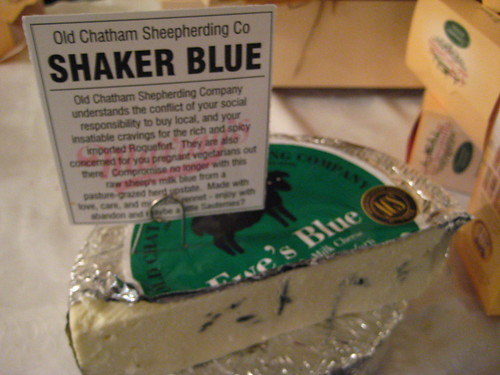
Shaker Blue:
Old Chatham Sheepherding Company, Old Chatham, NY. Raw sheep's milk, vegetable rennet, natural rind. Old Chatham was founded in 1994 by Tom and Nancy Clark with 150 East Freisian ewes. The flock now numbers over 1,000 that include Dorset Finn and various crosses. It is the largest sheep dairy in the US. Since beginning, Tom and Nancy wanted to create a Roquefort-style blue, but knew that they needed a separate aging facility in order not to cross-contaminate the molds. They built a cheese room on their land specifically for this style of cheese. Their first cheeses were called Ewe's Blue and is a pasteurized cheese. They expanded this by using raw milk and now also produce this, Shaker Blue, which is even closer to Roquefort than either Tom or Nancy initially envisioned. It is a moist, creamy semifirm cheese that has full, lingering flavors and a nicely measured saltiness with a sweet finish that are part of the richness of sheep's milk.

So that was it, some of these cheeses can be difficult to find if you're outside of the northeast, but many are available directly from the farms online (linked to in each entry).

It was a delightful evening and we hope to do this again with this group or others. Thanks Fran for inviting us, and thanks to all who came to the event. Enjoy the notes and don't be shy about asking questions!


NB: 90% of the photos on this post were borrowed from the cheesemakers' websites, Culture Magazine's cheese library, Formaggio Kitchen's website, and in the case of the Shaker Blue, from the blog: Blondie and Brownie. Thank you for your great photos as I did not have enough time to photograph while plating 23 individual plates. I hope you will excuse my shortcuts for the sake of informative illustrations and potential sales.

Thursday, January 20, 2011

A perfect meal

Yesterday was a pretty strange day. A lot of lateness all around due to strange unexpected things like missed trains and getting on the wrong one (oops), but upon coming home last night Aimee and I were faced with a dilemma - like a handful of nights every week - what to eat? We had some really nice roots in the fridge from our last CSA pick-up which also included some spinach along with the sweet potatoes, squash, turnips, etc. but there was little else and no real desire to do up a long roast in the oven on any of those roots. Neither one of us wanted to go back out in the slushy rain and (a) give up our parking space or (b) trudge through the night to get some just "okay" food.

Then Aimee made the suggestion that we do have some dried pasta and that got my mind working. Before I knew it I was preparing a dish that in my not-so-humble opinion could easily have been featured on a dining menu. Okay, I thought: Pasta? check; spinach? check; garlic? shallots? check and check; breadcrumbs? uh-oh, nope. I was thinking of doing a type of carbonara that I had in Rome with breadcrumbs, but since there was none to be had I just went with what there was.

The final dish was a divine mix of all of those plus some duck breast pastrami that I had left over from Formaggio Kitchen with a perfect poached egg on top. The pasta was a chipotle fettuccine cooked to a nice toothy al dente topped with a mix of shallots cooked in butter to which the duck pastrami was added then the spinach was steamed over making an incredible sauce. The poached egg was placed atop a nice mound of the spinach and the whole thing was sprinkled with finely chopped crispy garlic that I fried in some Mangalitsa pig rendered leaf lard and then grated some parmigiano reggiano over to combine (in lieu of breadcrumbs it was divine).

I of course didn't take a minute to photograph it because it was just dinner, but it remains in my memory this morning as incredible. What made it all the better was while I was cooking it and after we finished eating it, Aimee was reading out of a book that we are sharing right now, The Dirty Life: On Farming, Food, and Love by Kristin Kimball, which is about as romantic a book as I can imagine without sinking into the saccharine, and highly recommended.

The best thing I learned from the dinner was to not be afraid of poaching eggs. Most places I've seen information on poaching the egg say to boil the water and then tip the egg in while wrapping it around with a spoon so it doesn't completely break and sometimes vinegar is said to make it easier. Well, I broke the eggs straight from their shells into water that was just coming up to a boil (but wasn't there yet) and that had some white vinegar added to it. You know when you're watching a pot of water come to a boil there's that long stage where small bubbles are coming up the sides of the pot and it seems to take forever for the water to change from that state to even a simmer, let alone a boil? That is the time when I gently cracked and lowered my eggs into the water and kept them there for a good few minutes. I didn't stir with a spoon to keep everything together, I didn't even put the eggs into ramekins before slipping them in the water. This may not be news to anyone else, but I don't think I'll ever go back to the specially designed poaching pan that is über difficult to clean.